Cultural Alienation after Johanna’s Return
News of the WorldCultural Alienation after Johanna’s Return is the persistent estrangement between Johanna Leonberger’s life among the Kiowa and the German-American household to which she is returned. Her relatives treat homecoming as a recovery: they expect her to remember her parents, language, religion, and customs. But Johanna experiences their home as foreign, resists its demands, and remains, in Jefferson Kyle Kidd’s understanding, Kiowa at heart. The return changes where she lives without undoing the change captivity has made in who she is.
A Homecoming Already Out of Joint
Before reaching her relatives, Jefferson Kyle Kidd learns that Wilhelm Leonberger and Anna Leonberger live in D’Hanis, fifteen miles west, near the graves of the Leonberger couple and their little daughter. He keeps Johanna’s captivity and her parents’ fate from the surrounding community, anticipating that people would arrive in crowds and press her with attention. At St. Dominic’s, he removes his hat and holds it to his breast, observing the proper behavior he was taught long ago. Johanna looks at the headstones and weeping angels with curiosity but mostly indifference, then surveys a countryside transformed by plows and stone buildings. The grave and the settled landscape carry meanings for the adults that she does not appear to share.
Her request to return to Dallas makes the distance plain. Composed and quiet, she asks Jefferson Kyle Kidd to take her back and says she does not like the place. He tells her they cannot go. At the graveside she stands for a time, looks across the flat countryside, wipes her face, and climbs into the wagon. Her response is not a turn toward consolation: she braids her hair as if preparing for battle. The remembered Kiowa ethic of courage gives shape to her refusal to beg or plead, while her silence marks the beginning of an endurance rather than an adjustment she has chosen.
The Relatives’ Expectation of Recovery
Wilhelm Leonberger understands the return through practical and familial obligations. He says the household is prepared to take Johanna in, but also that she must learn their ways again and work; his wife needs help, and there is much to do. His attention to her unfamiliar way of sitting on the floor shows how ordinary habits have become signs of difference. Anna Leonberger asks whether Johanna thinks she is Indian and orders her to get up. Johanna ignores her. Jefferson Kyle Kidd warns the couple that she thinks of herself as Kiowa, needs quiet and gradual adjustment, has changed guardians three times, and is only ten. His appeal for patience meets a community eager to celebrate and reclaim her.
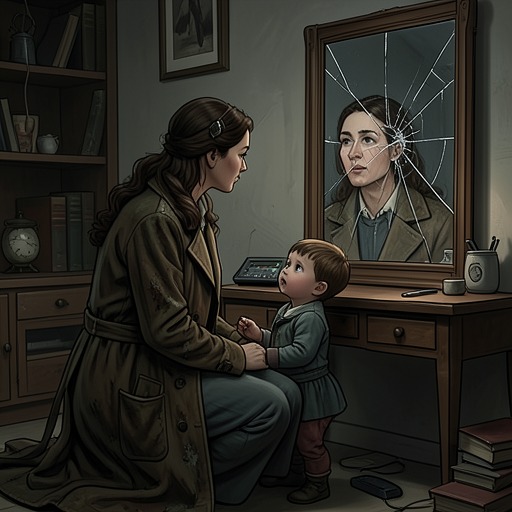
That eagerness fills the house with reminders intended to summon the child her relatives remember. Jefferson Kyle Kidd anticipates songs, praise, food, German words, tintypes of Johanna’s parents, and a dress she wore when she was six, all accompanied by the demand to remember. But inside the house Johanna crouches in a corner, hands clasped around her ankles, studying its possessions as strange objects. Daguerreotypes seem to her metal plates bearing odd arrangements of black and white; the drapes make no sense to her, since she cannot see why anyone would cover windows set into a stone wall. The unfamiliarity lies not only in language or family ties but in the meanings of domestic things that her relatives assume are self-evident.
Resistance in the Household
When the D’Hanis community gathers, Johanna refuses the social scene rather than participate in it. She will not leave the Curative Waters wagon bed or her red jorongo blanket for the night. The next day, as people arrive, she darts into the barn and climbs a ladder, her skirt tucked into her belt. When visitors try to speak to her in German, she throws down a sickle and a barking spud. Jefferson Kyle Kidd asks them to leave her alone for a while. His plea recognizes that their well-meant attempts to welcome her are also demands for access and recognition she cannot give.
The community nevertheless celebrates the return of one of its own. Its stone church and houses, gardens, Alsatian dishes, and Texas-style brisket express a settled communal identity; the priest thanks Jefferson Kyle Kidd for bringing Johanna back. Yet the celebration proceeds without her participation. Later, Anna Leonberger wipes her eyes and says she is glad Johanna has come back, while Johanna sings quietly to herself in Kiowa. The song’s meaning is uncertain to the adults around her, who imagine it might be a curse, a plea to the sun, praise for the Wichita Mountains, or a call for help. They can hear her voice, but cannot confidently understand what it says.
A Lasting, Unrepaired Division
Jefferson Kyle Kidd never understands how completely four years altered a child from a German household who was adopted into a Kiowa one. Johanna forgets her birth language, parents, people, religion, alphabet, use of knife and fork, and ability to sing in European scales. After her return, none of these comes back. The narrative states that she remains at heart Kiowa to the end of her days: a decisive limit on the relatives’ hope that instruction, work, food, or family keepsakes can simply restore the past.
Years later, in San Antonio, Johanna tries to pretend to be a white girl for Jefferson Kyle Kidd’s sake. She joins other girls on outings and in dancing lessons, rides sidesaddle, and carefully manages her knife, fork, and minute coffee spoon at dinner. But she watches Mexican women and girls washing clothes at Alazan Creek and San Pedro Springs with deep envy, while Jefferson Kyle Kidd sits with his hands in his lap, staring at his flan and feeling that the worst has happened. Her effort to perform the expected manners does not amount to belonging; his sadness registers his inability to make the life offered to her fit the one she has lost.
The Meaning of Return
The estrangement is not presented as a single refusal that time resolves. It recurs in Johanna’s request to go back to Dallas, her retreat to the wagon and barn, her Kiowa song among German-speaking relatives, and her later attempt to imitate white girls. The contrast between her relatives’ crowded welcome and her private withdrawal makes return itself a conflict: the adults see recovery, while Johanna encounters a world whose language, domestic objects, social rules, and remembered family history have become unfamiliar. Even her polished appearance as a teenager cannot erase that divide. Jefferson Kyle Kidd’s eventual recognition that nothing came back gives the homecoming its painful final measure: physical return restores proximity to kin, but not the identity they expect her to resume.